English
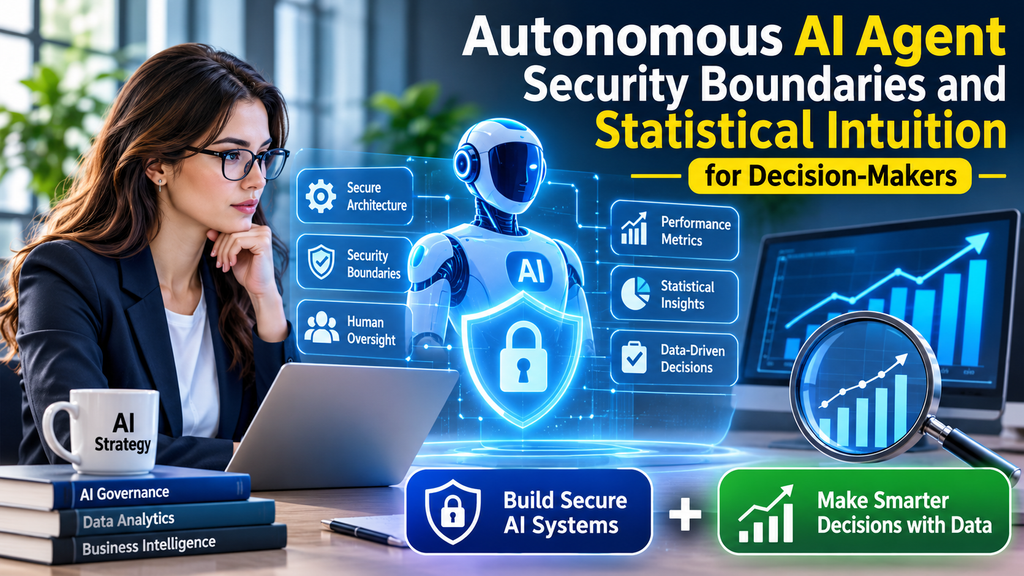


























































































































































































































































































































































































































































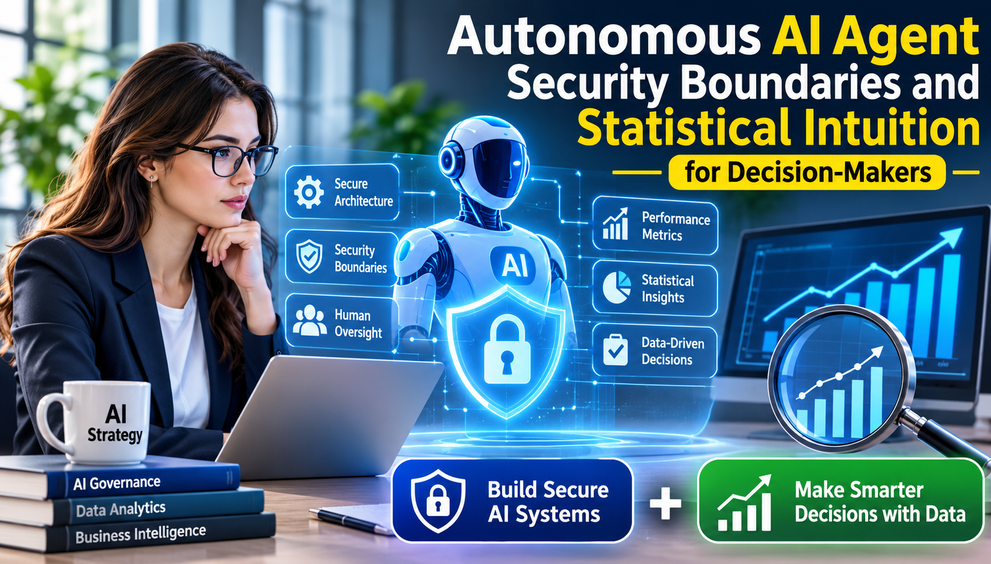
Autonomous AI Agent Security Boundaries and Statistical Intuition for Decision-Makers

Introduction
Artificial intelligence is moving beyond traditional automation toward autonomous systems capable of analyzing information, making decisions and executing tasks with limited human intervention.
These systems, commonly known as autonomous AI agents, are changing how organizations approach customer service, business operations, cybersecurity, financial analysis, and enterprise decision-making.
However, greater autonomy introduces new responsibilities.
Businesses must understand how AI agents access information interact with external systems process sensitive data and make decisions.
Without clearly defined security boundaries, autonomous systems can introduce operational risks, unauthorized actions, and unexpected outcomes.
At the same time, decision-makers need a practical understanding of statistics to evaluate AI performance and determine whether automated decisions are producing meaningful business results.
Combining secure AI architecture with statistical reasoning creates a stronger foundation for responsible innovation.
Understanding Autonomous AI Agents in Modern Business
Autonomous AI agents are software systems designed to pursue specific objectives through reasoning, planning tool usage and feedback. Unlike conventional automation which generally follows predefined instructions, AI agents can adapt their actions based on changing information and intermediate results.
For example, an enterprise AI agent might review customer requests retrieve information from internal databases prepare reports and recommend operational decisions.
More advanced implementations may interact with business applications or execute approved workflows.
Organizations developing these systems need to understand autonomous AI agents architecture and security boundaries to ensure that autonomy remains controlled and aligned with business requirements.
A well-designed architecture generally includes several important components:
* Reasoning layer: Interprets instructions and determines appropriate actions.
* Planning layer: Breaks complex objectives into manageable tasks.
* Tool integration: Connects the agent with approved APIs, databases, and enterprise applications.
* Memory management: Maintains relevant information across interactions.
* Security controls: Restricts access, permissions, and operational capabilities.
* Monitoring mechanisms: Tracks decisions, activities, errors, and unusual behavior.
These components should operate within a clearly defined governance framework rather than allowing unrestricted access to organizational resources.
Why Security Boundaries Matter for Autonomous Systems
The most significant difference between traditional software automation and autonomous AI systems is the degree of operational independence.
An agent may interpret an instruction, select a tool, retrieve information, and initiate an action. If its permissions are excessive, a single incorrect decision could affect multiple systems.
For this reason, organizations should implement security boundaries before deploying autonomous agents in production environments.
1.Principle of Least Privilege
Every AI agent should receive only the permissions necessary to complete its assigned responsibilities.
For example, an agent responsible for analyzing sales reports should not automatically receive permission to modify customer accounts or approve financial transactions.
Separating read-only access from write permissions reduces the potential impact of incorrect or manipulated instructions.
2.Human Approval for High-Impact Actions
Not every AI-generated decision should be executed automatically.
Businesses should identify actions that require human authorization, including:
* Financial transfers and payment approvals.
* Changes to employee records.
* Deletion of important business information.
* External communications involving sensitive information.
* Modifications to production infrastructure.
A human approval mechanism creates an additional layer of accountability without eliminating the efficiency advantages of automation.
3.Protection Against Prompt Injection
AI agents frequently process external information, including emails, documents, websites, and customer submissions. Some of these sources may contain malicious instructions designed to manipulate an agent.
Organizations should treat retrieved content as untrusted input, separate instructions from data, validate tool calls, and restrict access to sensitive resources.
4.Logging and Continuous Monitoring
Security teams need visibility into agent activities.
Detailed logs should record tool usage, permission checks, decisions, approvals, and execution outcomes.
Monitoring also helps organizations identify unusual behavior, investigate incidents, and improve system reliability.
Connecting AI Security with Enterprise Governance
Effective AI governance requires more than technical security controls.
Organizations must establish clear ownership operational policies testing procedures and accountability structures.
A useful approach is to classify AI agents according to their potential business impact.
Low-risk agents may perform research, summarize documents or organize non-sensitive information.
Medium-risk agents may interact with internal business applications under restricted permissions.
High-risk agents may influence financial, legal, employment, or infrastructure-related decisions and therefore require stronger supervision.
This classification helps organizations apply security controls proportionately rather than imposing identical restrictions on every implementation.
Regular security assessments should also examine authentication API permissions data retention third-party integrations and the ability to stop an agent when unexpected behavior occurs.
Statistical Intuition: Making Better Decisions About AI Performance
Security determines what an AI system is allowed to do, but performance measurement determines whether it is doing those things effectively.
Business leaders do not necessarily need advanced mathematical expertise to evaluate AI systems. However, they should understand the statistical concepts behind performance indicators.
Developing statistical intuition for decision-makers and key metrics helps executives distinguish meaningful improvements from misleading numbers.
Several statistical concepts are particularly valuable.
1 .Average and Median
The average provides a general measure of performance, but extreme values can distort the result.
For example, suppose an AI-powered customer support system resolves most requests within five minutes, while a small number take several hours. The average resolution time may appear disappointing even when most customers receive fast assistance.
The median provides a better understanding of the typical experience because it is less affected by unusually high or low observations.
2 .Variance and Standard Deviation
Two AI systems may have identical average response times but very different levels of consistency.
One system might consistently respond within a narrow time range, while another produces highly unpredictable results.
Variance and standard deviation help decision-makers understand how much performance fluctuates around the average.
This is particularly important for enterprise applications where predictable performance matters as much as speed.
3 .Correlation Versus Causation
Businesses often observe improvements after introducing AI technology and immediately attribute those improvements to automation.
However, correlation does not automatically establish causation.
For example, increased sales following an AI implementation might also result from seasonal demand, marketing campaigns, pricing changes, or improved product availability.
Controlled experiments and appropriate comparison groups can help organizations determine whether AI actually contributed to the improvement.
4 .Precision and Recall
Precision and recall are particularly useful when evaluating AI systems responsible for identifying relevant information or detecting specific events.
* Precision measures how many positive predictions were actually correct.
* Recall measures how many actual positive cases the system successfully identified.
Consider an AI fraud detection system. High precision reduces unnecessary fraud alerts, while high recall helps identify more genuine fraudulent transactions.
The appropriate balance depends on the business consequences of false positives and false negatives.
Using Statistical Metrics to Evaluate Autonomous AI Agents
Autonomous agents should not be evaluated solely on how quickly they complete tasks. Their accuracy, reliability, security, and operational impact must also be considered.
Organizations can establish measurable performance indicators such as:
| Performance metric | Business significance |
| ———————– | ————————————- |
| Task completion rate | Measures successful task execution |
| Error rate | Identifies incorrect outcomes |
| Human intervention rate | Measures dependence on manual support |
| Response latency | Evaluates processing speed |
| Tool-call failure rate | Identifies integration problems |
| Security incident rate | Tracks security-related failures |
| Cost per completed task | Measures operational efficiency |
These indicators should be assessed across different scenarios rather than relying on a small number of successful demonstrations.
For example, an agent that completes 95% of routine tasks successfully may still perform poorly when encountering unusual instructions, incomplete information, or unexpected system responses.
Testing should therefore include normal operations, edge cases, adversarial inputs, and failure-recovery scenarios.
Building a Responsible AI Decision-Making Framework
The strongest enterprise AI strategies combine technical architecture with measurable governance practices.
A practical implementation framework can follow five stages.
Stage 1: Define the business objective
Organizations should identify the specific problem an autonomous agent is expected to solve. Clear objectives make it easier to establish permissions and evaluate outcomes.
Stage 2: Establish security boundaries
Define access permissions, authentication requirements, approval mechanisms, data restrictions, and emergency shutdown procedures before deployment.
Stage 3: Establish measurable performance indicators
Select metrics that reflect actual business objectives. Avoid relying exclusively on headline accuracy figures or task completion percentages.
Stage 4: Conduct controlled testing
Evaluate performance under realistic operating conditions, including unusual inputs, integration failures, and security threats.
Stage 5: Monitor and improve continuously
Review performance data, investigate incidents, update permissions, and refine workflows as business requirements evolve.
This approach makes AI deployment a continuous governance process rather than a one-time technology implementation.
Conclusion
Autonomous AI agents offer organizations significant opportunities to improve productivity, automate complex workflows and support faster decisions.
However, their growing capabilities also introduce security, accountability, and reliability challenges.
Businesses need clearly defined security boundaries restricted permissions human oversight and continuous monitoring to ensure that autonomous systems operate responsibly.
Equally important is the ability of business leaders to interpret statistical evidence. Understanding averages variability correlation precision recall and operational performance indicators allows organizations to evaluate AI systems using meaningful evidence rather than assumptions.
Ultimately, successful enterprise AI adoption depends on combining intelligent automation with disciplined security architecture and sound statistical decision-making.
Organizations that bring these elements together will be better positioned to achieve sustainable efficiency while maintaining trust, control, and operational resilience.